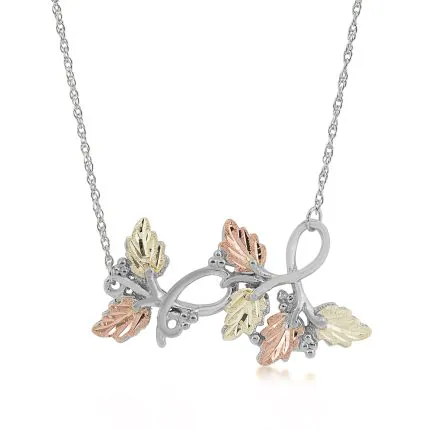



Landstrom’s Black Hills Gold Rose Bracelet, a symbol of timeless beauty and elegance. Crafted with precision and attention to detail, this bracelet features a delicate 10K frame adorned with a single rose, evoking the romance of nature’s blooms. Intricate grape clusters and winding vines intertwine gracefully, while delicate 12K green and rose leaves add a touch of natural allure. Suspended from a gold-filled chain, this bracelet exudes sophistication and charm. Whether worn as a daily accessory or for special occasions, it serves as a reminder of the enduring allure of Landstrom’s Black Hills Gold craftsmanship. Embrace the enchanting beauty of roses and vines with this exquisite bracelet.
The origins of Black Hills Gold date to the 1870’s, designed by a French goldsmith named Henri LeBeau. Although it is known that it was the South Dakota gold rush that brought LeBeau to the region, the inspiration for the grape leaf design is steeped in myth. As the legend goes, the intrepid LeBeau was seeking gold in the Black Hills wilderness when he became completely lost. After days of wandering in search of food and water, he had what he thought was a vision of grapes on a vine. The fruit was real, and so was the stream that ultimately saved him from starvation and thirst. Inspired by his life-changing experience, LeBeau designed the grape and leaf design we associate with Black Hills gold to this day.
Trained by Henri LeBeau, S.T. Butler opened the first Black Hills gold manufacturers in 1878. After dividing into two companies in 1919, both were acquired by Ivan Landstrom in 1944 and 1995.
Although there are several manufacturers of Black Hills gold, Landstom's techniques for creating the grape leaf design are varied. The old fashioned method involves lots of hand finishing techniques, giving each piece a unique touch. This technique starts with the rolling out of colored gold alloys into thin sheets. The leaf shape is then stamped out of the sheets and soldered on to the jewelry. The classic woodgrain texture is created through a technique called “wriggling”, and then the leaf veining is hand engraved.

Reviews
There are no reviews yet.